
News

NEWS
2025-05-23
Technical Information

The Relationship Between Industry 4.0 and RFID

Share:

Industry 4.0 represents this generation’s vision for production and manufacturing—bringing together the world’s existing technologies, including the Internet, Cloud Computing, Big Data, Automated Production Machinery, ERP, and MES systems.

Its goal is to maximize integration capabilities, drastically reduce manual labor, and enhance 24/7 factory productivity, ultimately enabling unmanned factories, remote control, and data-driven analytics.

Therefore, Industry 4.0 is not just a technical upgrade, but a conceptual advancement that accelerates global industrial development. It is a major undertaking and milestone, symbolizing humanity’s ability to integrate and apply diverse technologies.

Within the framework of Industry 4.0, the RFID system acts as the neural network that connects the Internet, Cloud, Big Data, automated machinery, ERP, and MES.

In every industrial production process, the principle of “one item, one code” has always existed. In the past, this relied on handwritten notes or manual data entry; later it advanced to barcode scanning. However, these methods still depend heavily on human effort and time.

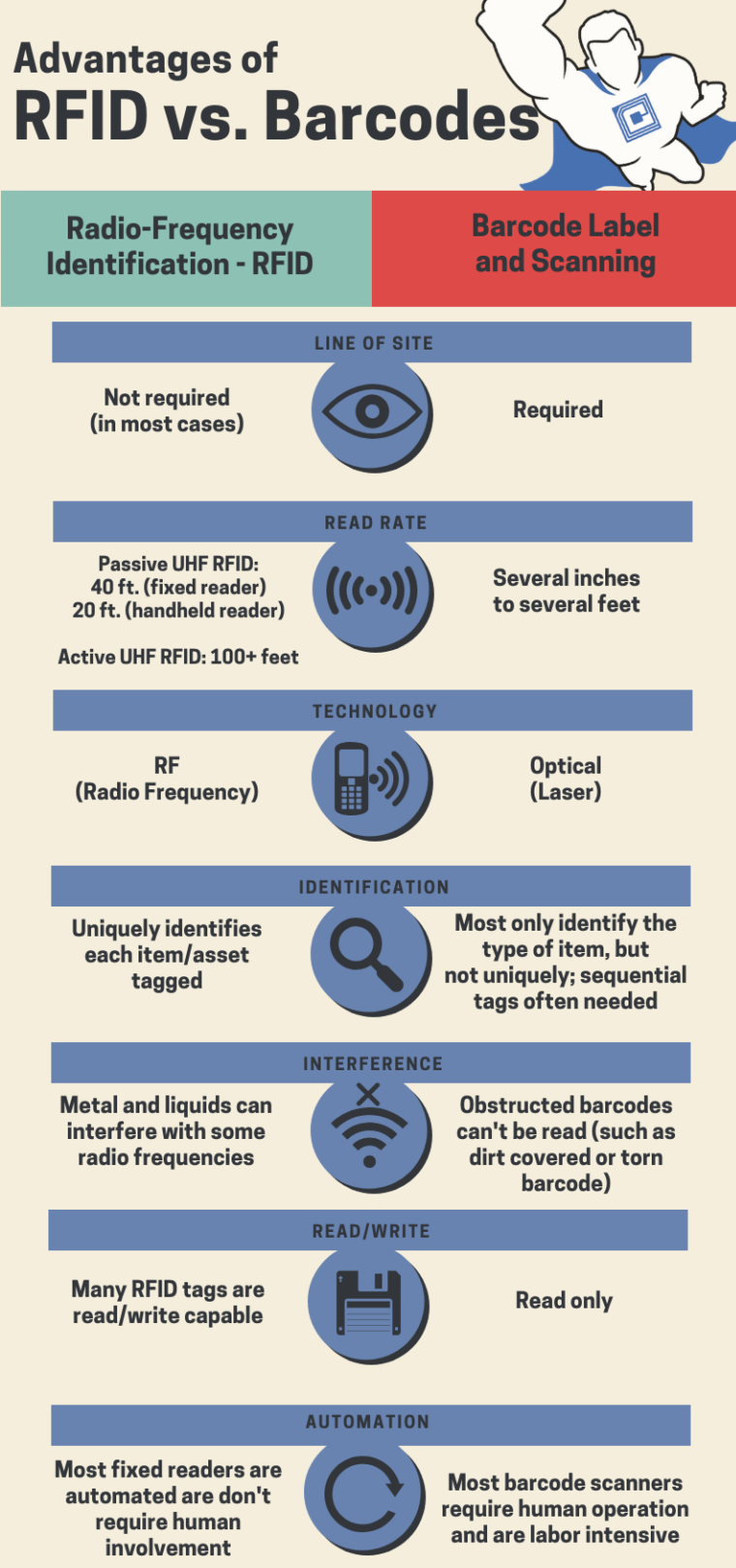
By contrast, RFID systems allow for fast data reading and rewriting, as well as simultaneous multi-item scanning. This not only minimizes the need for manual labor but also provides unique product identifiers and complete production histories—ensuring non-repetition, anti-counterfeiting, and traceability.

(Comparison chart below illustrates the advantages of RFID over traditional methods.)
 

RFID-vs.-Barcodes-Infographic-v2-768x1920


When viewed from the aspects of labor costs and factory automation, it is evident that RFID, compared to barcodes, better embodies the essence of Industry 4.0.


Related Information

2025-04-21
Technical Information

What is a Data Capture System (RFID)?

A Data Capture System (RFID) is a wireless communication technology that identifies specific targets and reads or writes related data through radio signals.

Language

In accordance with the EU General Data Protection Regulation (GDPR), we are committed to protecting your personal data and providing you with control over your information.
By clicking “Accept All,” you consent to our use of cookies to enhance your browsing experience, help us analyze website performance and usage, and deliver relevant marketing content. You may manage your cookie preferences below. By clicking “Confirm,” you agree to the current settings.

Manage Cookies

Privacy Preference Center

In accordance with the EU General Data Protection Regulation (GDPR), we are committed to protecting your personal data and providing you with control over your information.
By clicking “Accept All,” you consent to our use of cookies to enhance your browsing experience, help us analyze website performance and usage, and deliver relevant marketing content. You may manage your cookie preferences below. By clicking “Confirm,” you agree to the current settings.

View Privacy Policy

Manage Consent Settings

Necessary Cookies

Always Enabled

These cookies are essential for the operation of the website and cannot be disabled in our systems. They are usually set only in response to actions you take, such as requesting services, setting your privacy preferences, logging in, or filling out forms. You can set your browser to block or alert you about these cookies, but some parts of the site may not function properly as a result.